
Wedging Without the Wrist Pain
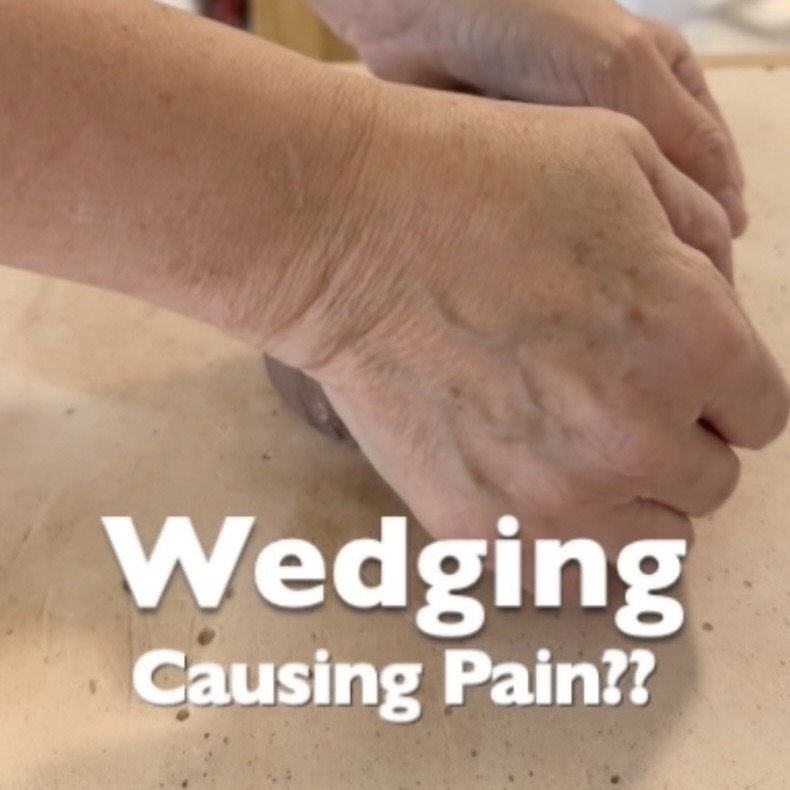
How do you wedge clay without ruining your wrists? Wedging is a notoriously uncomfortable part of pottery making, but you can eliminate joint strain by shifting from manual muscle force to full-body weight mechanics.
The Fix: Shift to Body Weight Mechanics
Instead of isolating your hands, wrists, and arms to force the clay down, use an athletic stance to protect your upper body:
Stagger Your Stance: Place one foot firmly behind the other to build a stable, solid base.
Plant Your Hands: Lock your hands onto the clay and keep them in a supportive position.
Lean and Turn: Keep your arms straight. Lean your entire body weight into the clay to move it, rather than pushing with isolated arm strength.
Keep a Neutral Wrist: Ensure your wrist stays straight and in line with your elbow and fingers. Never exert force while your joint is bent or twisted.
See video for demonstrations of this technique.
The Trade-offs of "Stack and Slam"
The stack-and-slam method (wire wedging) is a popular alternative that spares your wrists, but it introduces different ergonomic strain:
Shoulder Work: Slicing and slamming trades wrist fatigue for heavy shoulder and core work.
The Floor Setup Pitfall: Slamming clay onto the floor gives you great leverage, but forces you to repeatedly bend over to pick it up, transferring the stress directly to your lower back.
The Golden Rule: Only Wedge Soft Clay
Forcing hard, stiff clay is completely unnecessary and highly detrimental to your longevity in the studio. The intense resistance doesn't stop at your fingers—it radiates strain directly up into your forearms, shoulders, and back. For repetitive, forceful studio preparation, always prioritize soft, well-hydrated clay.
Filmed on location at Carved in Mud Studios in Richmond, VA.